
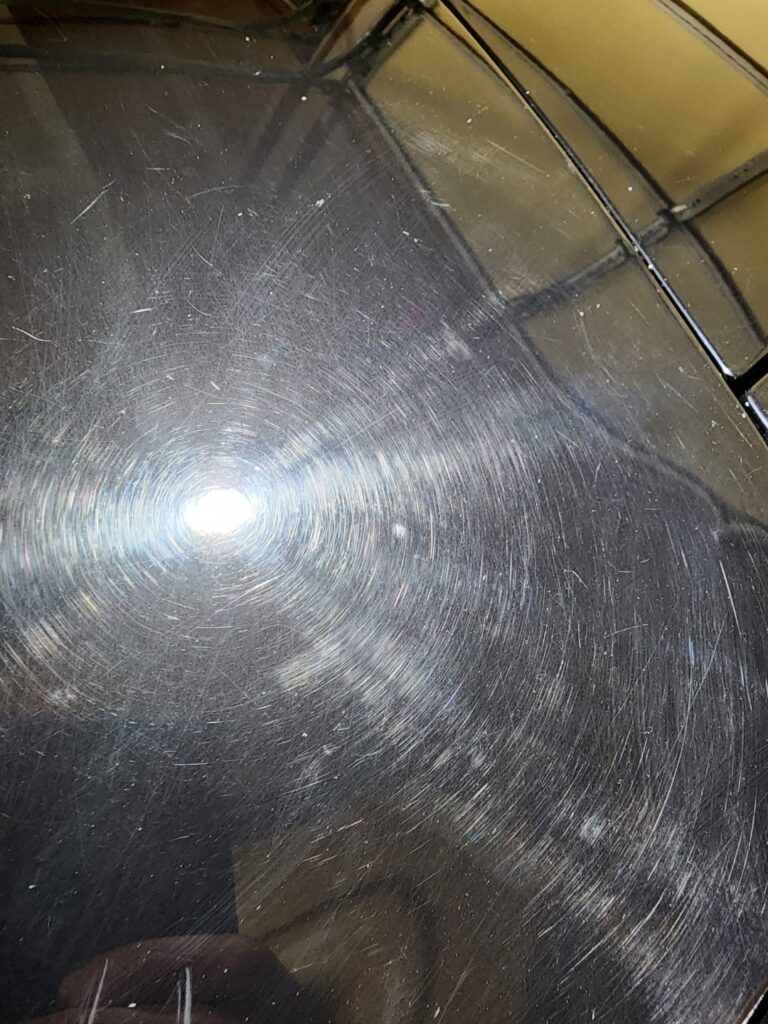
When we walk a customer’s car before giving a quote, one of the most common reactions is “I didn’t realize there was that much wrong with it.” Most people can tell their paint looks a little dull or “off” somehow, but very few can tell the difference between swirl marks and actual scratches — and that distinction is exactly what determines how much correction work (and how much price) a car actually needs.
What Swirl Marks Actually Are
Swirl marks are a web of fine, circular scratches that sit on the surface of the clear coat. They almost always come from washing technique: automatic touch car washes, dirty wash mitts, drying with the wrong towel, or using a machine buffer with too much pressure. Under normal daylight they’re often invisible, which is exactly why so many cars have them without the owner ever noticing. They only show up under direct sunlight or angled light, where they create that hazy, spiderweb pattern people associate with a “tired” looking paint job.
Because swirl marks live in a thin layer of the clear coat, they’re usually the easiest defect to correct. A single-stage polish (what we’d call Level 1 correction) is often enough to level them out and restore clarity.
What an Actual Scratch Is
A real scratch is a more isolated, linear mark that you can usually feel with a fingernail if it’s deep enough. Scratches happen from specific contact events — a key, a branch, a shopping cart, brushing against something while parking — rather than from general washing wear. Depending on depth, a scratch might sit entirely within the clear coat (correctable), or it might cut through the clear coat into the base color coat or primer underneath, which polishing alone cannot fix.
Why This Distinction Drives the Price
Swirl marks across an entire car are often addressed efficiently in one correction pass, since the defect is uniform and shallow. Scratches require more targeted, careful work, especially if some are deep enough to need spot leveling or if a few have gone through the clear coat entirely and need touch-up paint or body shop attention instead of correction.
A car covered in light swirls but with no real scratches usually quotes lower than a car with fewer overall marks but several deep scratches scattered across multiple panels, because the deep scratches take more time, skill, and risk to address safely.
How to Check Before You Call
Run your fingernail very lightly across a mark (carefully, on a clean panel) — if you can’t feel it but can see it in harsh light, it’s likely a swirl. If you can feel a groove, it’s a scratch, and its depth will determine what’s realistically achievable.
Get an Honest Read on Your Paint
Photos and guesswork only go so far here. The most accurate way to know what you’re dealing with, and what it’ll cost to fix, is having it looked at under proper lighting.
See our Paint Correction page or call 877-543-1085 for a same-day quote once we’ve actually seen what your paint needs.